What Engineering-Based Cost Segregation Actually Looks Like
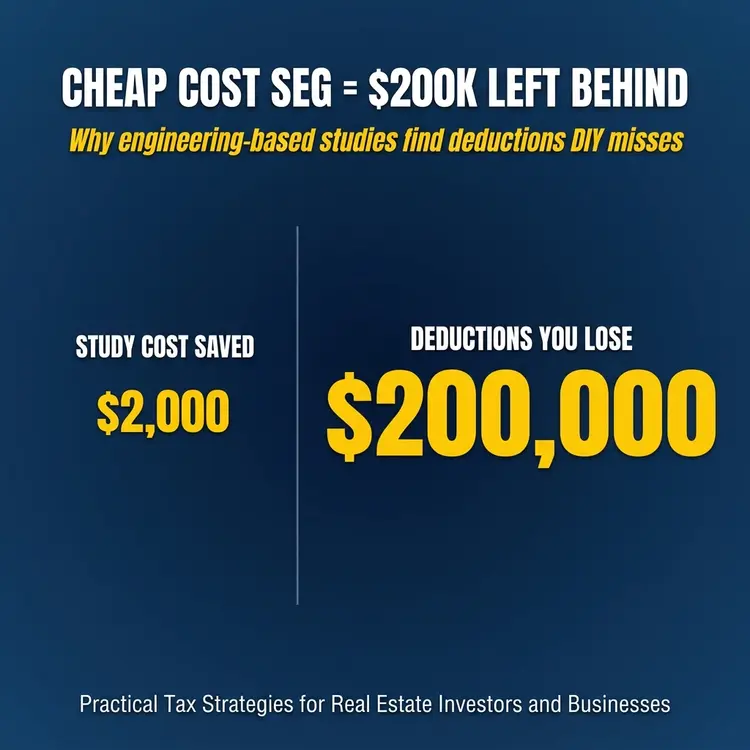
Engineering-based cost segregation studies use site inspections, blueprints, and construction documentation to reclassify a meaningful share of your property's cost basis into accelerated depreciation. Residential properties generally land in the 20% to 40% range, though it varies, and commercial results depend entirely on the property type and asset class. The IRS treats this approach as the most reliable and most accurate because it produces defensible documentation that cheaper methods miss, often leaving six figures in deductions unclaimed.
Engineering-based cost segregation applies construction expertise to dissect every component of your property and maximize tax deductions. Here's what separates this approach from generic alternatives:
-
Physical site visits document actual installed components, not assumptions from photos
-
Multidisciplinary teams (engineers, construction professionals, tax specialists) classify each building element
-
RS Means database assigns precise costs to 92,000+ components across 970+ U.S. locations
-
IRS-compliant documentation withstands audit scrutiny (CSSI has produced over 65,000 engineering-based studies)
-
Worth a free estimate on properties with a cost basis of $150,000 or more excluding land, both commercial and residential
How Engineering-Based Cost Segregation Works
An engineering-based cost segregation study dissects construction costs through detailed site inspections, architectural drawings, mechanical plans, electrical plans, and contractor invoices. The IRS states clearly: "In general, a study by a construction engineer is more reliable" than one conducted without engineering or construction background.
The difference isn't about credentials. The difference is what gets captured and how defensible your depreciation schedule becomes when examined.
What Happens During a Physical Site Visit
When a trained professional conducts an in-person site visit, they're taking photographs and measurements that capture exactly what the engineers need to see. Inside and outside the building, they document specific details that determine how individual components get classified.
In a virtual study, you send photos you've taken yourself. The problem is you don't know what the engineers are looking for. You miss the details that create opportunities to accelerate more depreciation.
The engineers need to verify what was installed.
Change orders and field modifications during construction create variations from the original blueprints. A site visit documents these deviations and reveals how they affect component classification. Without physical verification, you're working from assumptions about what's in the building rather than documented reality.
Bottom line: Physical inspections capture installation details that photos and blueprints alone miss, leading to more accurate classification and larger deductions.
How Component-Level Classification Identifies Hidden Deductions
Engineering-based studies use multidisciplinary teams (engineers, construction professionals, and tax specialists) to analyze every aspect of a property. Electrical systems. Plumbing. Flooring. Landscaping. The depth is impossible to replicate when property owners or accountants try to handle classification without technical expertise.
When I walk through a rental property with someone unfamiliar with cost segregation, I point to specific components and explain what qualifies as 5-year property instead of 39-year.
Flooring that's not permanent. Cabinets. Countertops. Wall coverings. Wall treatments. Window treatments.
These are the non-structural parts of the inside of a building. Specialty plumbing and electrical systems qualify as 5-year property. Land improvements fall into the 15-year category. Both categories are eligible for bonus depreciation.
The critical distinction is understanding how portions of specialty systems relate to specific business processes versus basic building functions. Engineers determine which portions of electrical circuits, telecommunications, or exhaust systems qualify as personal property rather than structural components.
How Engineers Assign Costs to Each Component
Engineers assign costs to every component using RS Means, the construction industry's standard cost database. RS Means contains over 92,000 unit cost line items updated annually, covering material, labor, and equipment costs across 970+ U.S. locations.
The IRS recognizes RS Means as an acceptable cost source for cost segregation studies. When you're working from construction documentation (blueprints, specifications, contracts, job reports, change orders, payment requests, and invoices), you're using the most methodical approach available.
Fully engineered studies consistently identify higher percentages of property qualifying for accelerated depreciation compared to statistical methods. On residential property, reclassification generally runs 20% to 40%, though it varies with the building. On commercial property it depends entirely on the property type and asset class, so there is no honest general range to quote. Statistical studies don't match this level of precision.
Bottom line: Component-level analysis by engineers identifies which building elements qualify for 5-year, 15-year, or 39-year depreciation. On residential property that generally moves 20% to 40% of cost basis into shorter asset lives; on commercial property the result depends on the property type and asset class.
Why Documentation Standards Matter If You're Examined
Engineering-based cost segregation studies are defensible in IRS audits because they include comprehensive documentation, detailed calculations, and IRS compliance. The study withstands scrutiny.
CSSI has produced over 65,000 engineering-based studies. When clients are audited for other reasons, we defend the study at no charge for as long as needed.
That defense is possible because the detailed engineering approach produces well-documented and substantiated findings. Engineers conduct thorough on-site inspections, review construction documents, and allocate costs based on specific building components.
Without property-specific engineering analysis and supporting documentation, defending your depreciation schedule becomes more challenging if questioned by tax authorities.
DIY and AI-driven studies often rely on generic assumptions and user-entered data. This leads to misclassified assets and reports that fail to meet IRS documentation standards. The cheap study isn't cheap if it leaves six figures of deductions on the table or leaves you with nothing to show an examiner.
Bottom line: Engineering-based studies provide IRS-compliant documentation that withstands audit scrutiny, while cheaper alternatives leave thinner documentation and miss deductions.
Why Ground-Up Construction Offers the Cleanest Opportunity
Ground-up construction offers the cleanest opportunity for a precise and defensible cost segregation study. All data is current, detailed, and verifiable through construction invoices, architectural drawings, and engineering specifications.
You design your tax advantage as you build.
In ground-up construction on residential property, 20% to 40% of total building costs typically get reclassified into shorter asset lives, though it varies with the building. On commercial property the result depends on the property type and asset class. Proper categorization during construction enables accelerated depreciation claims on non-structural components immediately.
The difference between capturing these deductions correctly and missing them compounds over time. This isn't about the first year's tax benefit. This is about the cash flow impact across the entire depreciation schedule.
Bottom line: Ground-up construction provides complete documentation, which supports the most precise reclassification the property type and asset class allow.
What Most CPAs Miss About Cost Segregation
Many tax preparers aren't familiar with cost segregation studies and how they're applied to tax returns. Some aren't aware that short-term rental income qualifies as non-passive if the owner meets material participation rules.
Some don't want to deal with it.
The hesitation often comes from unfamiliarity with how to apply a cost segregation study to a tax return. We help them with this. The structural issue is that cost segregation requires work beyond standard tax preparation, and many preparers aren't set up to handle it.
This creates a gap between what clients assume their CPA is doing and what's being done.
Property owners believe their tax professional is optimizing strategy when they're only executing compliance. The difference matters because tax preparation and tax strategy are not the same thing.
Bottom line: Most CPAs focus on tax preparation (compliance), not tax strategy (optimization). Cost segregation requires engineering expertise they don't have.
When Cost Segregation Doesn't Make Sense
I tell potential clients a cost segregation study isn't right for them if:
-
The cost basis, excluding land, is under $150,000
-
They plan on selling without doing a 1031 exchange within the next 3 or 4 years
-
They don't pay enough tax to warrant accelerating the depreciation
-
They're high income but the deductions will only apply to passive income and they don't have much passive income
If I don't feel a study would benefit a client, I refer them to their tax preparer. I have them take our free estimate to their tax preparer and verify the fit.
This conversation matters because honesty about when cost segregation doesn't work builds more trust than selling studies that don't serve the client's situation.
Bottom line: Cost segregation is worth a free estimate on any property with a cost basis of $150,000 or more excluding land, and it works best when you have taxable income to offset and plan to hold the property long-term or execute a 1031 exchange.
Four Misconceptions That Keep Investors from Acting
Misconception 1: Your CPA will handle it for you. CPAs don't conduct engineering-based studies. They apply the results to your tax return, but they're not equipped to perform the analysis.
Misconception 2: Cost segregation is too expensive. Study cost depends on the building, so nobody can quote you a real number without details. For CSSI, roughly $2,000 is the very low end, and it goes up with the type of study, the type of building, and the complexity. That's why the estimate is free. You see the actual study cost and the estimated tax benefit before you commit to anything.
Misconception 3: It only works for commercial properties. The methodology applies to both residential and commercial properties. The component analysis doesn't change based on property type.
Misconception 4: You've owned the property too long. A look-back study lets you claim depreciation you missed in prior years without refiling those returns. My own rule of thumb is that properties owned roughly 15 years or less are the ones most likely to show a worthwhile benefit, but that's how I screen candidates, not a limit written into the code.
Bottom line: Cost segregation works for both commercial and residential properties, the study cost is quoted per building after a free estimate, and look-back studies let you claim depreciation you missed on property you already own.
Why the IRS Treats Engineering-Based Studies as the Most Reliable
The IRS Cost Segregation Audit Techniques Guide does not certify any single provider or method. What it does say is that a study by a construction engineer is more reliable than one prepared by someone without an engineering or construction background.
Database studies, rule-of-thumb studies, and do-it-yourself studies exist in the market. They appear legitimate through lower pricing. The reduced cost comes with reduced accuracy, which frequently results in diminished tax savings.
The money saved on study fees is often dwarfed by lost deductions. The bargain approach becomes expensive in the long run.
When you're making decisions about significant capital and long-term tax consequences, the methodology matters. Engineering-based studies provide the documentation, precision, and defensibility that other approaches don't match.
Bottom line: The IRS treats engineering-based studies as the most reliable and most accurate because they provide defensible documentation. Cheaper alternatives sacrifice accuracy and leave deductions unclaimed.
Frequently Asked Questions
What is an engineering-based cost segregation study?
An engineering-based cost segregation study uses construction and engineering expertise to analyze your property's components and reclassify them into shorter depreciation schedules (5-year, 15-year, or 39-year). Engineers conduct physical site visits, review blueprints and construction documents, and assign costs using the RS Means database to identify which components qualify for accelerated depreciation.
How much of my property's cost basis gets reclassified?
It depends on the building. Residential properties generally land between 20% and 40%, though that varies. Commercial results depend entirely on the property type and asset class, so there is no honest general range to quote. A free estimate gives you the number for your specific property before you commit to a study.
Do I need an engineering-based study or will a cheaper option work?
The IRS treats engineering-based studies as the most reliable and most accurate approach because they provide defensible documentation. Database studies, DIY tools, and AI-driven options often miss significant deductions and leave you with thinner documentation if your return is examined because they rely on generic assumptions rather than property-specific analysis. The money saved on a cheap study is typically dwarfed by the deductions you leave unclaimed.
Will a cost segregation study trigger an IRS audit?
Nothing about a study changes how the deduction gets reported. It applies existing depreciation rules to the components of a building you already own, and the result flows onto the return like any other depreciation schedule. CSSI has produced over 65,000 engineering-based studies. If your return is examined for any reason, the component-level documentation and the IRS-compliant methodology are what you hand over.
Does cost segregation work for residential rental properties?
Yes. The component-level analysis applies to both commercial and residential properties. The methodology doesn't change based on property type. Many investors assume cost segregation only works for commercial properties, but a residential property with a cost basis of $150,000 or more excluding land is worth a free estimate under the same reclassification approach.
How long after purchasing a property do I have to complete a cost segregation study?
There is no statutory deadline. A look-back study claims the depreciation you missed in prior years as a catch-up adjustment in the current year, without refiling those returns. My rule of thumb is that properties owned about 15 years or less tend to be the ones where the benefit is worth the study, but that's how I screen candidates rather than a legal limit. Sooner is better either way, because you accelerate the cash flow.
What if my CPA says I don't need cost segregation?
Many CPAs focus on tax preparation (compliance) rather than tax strategy (optimization). Some aren't familiar with how to apply cost segregation studies to tax returns. Others don't want to handle the additional work. Get a free estimate and have a conversation with your CPA about whether the timing and tax benefit make sense for your situation.
What documentation do I need to provide for a cost segregation study?
For purchased properties, you'll need the purchase agreement, closing statement, and any available construction documents. For ground-up construction, you'll provide blueprints, specifications, contractor invoices, change orders, and payment requests. The engineering team conducts a physical site visit to document actual installed components and verify construction details.
Get Your Free Cost Segregation Estimate
If you own commercial or residential property with a cost basis of $150,000 or more excluding land, contact me for a free estimate. You'll receive the actual study cost and estimated tax benefit with minimal information required.
The estimate shows exactly what you stand to gain. Take it to your tax preparer and have a conversation about whether the timing makes sense for your tax situation and your property plans.
The difference between understanding what engineering-based cost segregation looks like and assuming all studies are the same often means leaving six figures of deductions on the table. You have access to the information needed to make an informed decision upfront.
Call me at (770) 224-8504 ext. 2 for your free cost segregation estimate. The risk of leaving deductions unclaimed isn't worth taking when you have clarity available.
Key Takeaways
-
Engineering-based cost segregation uses physical site visits, blueprints, and construction documentation to identify components that qualify for accelerated depreciation.
-
Multidisciplinary teams (engineers, construction professionals, tax specialists) classify each building element using the RS Means database, which contains 92,000+ unit cost line items across 970+ U.S. locations.
-
On residential property, engineering-based studies generally reclassify 20% to 40% of cost basis into shorter depreciation schedules (5-year and 15-year property), though it varies by building. On commercial property the result depends entirely on the property type and asset class. Either way, engineered studies significantly exceed the precision of statistical or database methods.
-
The IRS treats engineering-based studies as the most reliable and most accurate because they provide comprehensive documentation that withstands audit scrutiny. CSSI has produced over 65,000 engineering-based studies.
-
Cost segregation works for both commercial and residential properties, and a cost basis of $150,000 or more excluding land is worth a free estimate. Look-back studies let you claim depreciation you missed on property you already own without refiling prior returns; as a rule of thumb, properties held about 15 years or less are the strongest candidates.
-
Most CPAs focus on tax preparation (compliance) rather than tax strategy (optimization). Cost segregation requires engineering expertise separate from standard tax preparation services.
-
Cheaper alternatives (database studies, DIY tools, AI-driven options) sacrifice accuracy and typically leave significant deductions unclaimed. The money saved on study fees is dwarfed by lost tax benefits.

CEO of Cashflow Strategies, Inc., Tax Strategist, Speaker, Educator
David “Mr. Cash Flow” Wiener is a nationally recognized authority on real estate tax strategy and cash flow optimization, and the host of The Tax Strategy Playbook podcast. As Founder and CEO of Cash Flow Strategies, Inc., David has spent decades helping real estate investors, business owners, and their advisory teams legally reduce taxes, unlock hidden cash flow, and put more money back into productive assets instead of into the IRS.
Over the course of his career, David has become especially known for his work with cost segregation, 179D energy-efficient commercial building deductions, and other engineering-based tax incentives that accelerate depreciation and free up capital. He has also built a long track record in cash flow and accounts receivable optimization, helping clients improve profitability and financial stability without simply “working harder” or taking on more risk.
David is a sought‑after speaker, trainer, and educator, with audiences ranging from national industry conferences to small mastermind groups and professional associations. He is known for his clear, practical teaching style and his ability to translate complex tax concepts into simple, actionable plays that investors and advisors can use right away. Whether he is speaking to CPAs, medical and dental practice owners, or real estate investors, David’s message is consistent: tax strategy is one of the most powerful—and most overlooked—wealth multipliers available.
On The Tax Strategy Playbook, David brings that same real‑world experience and teaching approach to the microphone. Each epis… Read More

Is Solar Still 5-Year Property? What Changed for Projects That Started After 2024